Charges
Use Charges to define the cost types your company records for carrier, vendor, and operational expenses.
Charges are the cost side of settlement. Services are the customer billing side.
Before you start
Make sure that:
- item charges or G/L accounts are available if costs are posted to Business Central financial documents,
- vendors and carriers are created,
- Freight Agreements are configured if charges are copied from carrier agreements,
- settlement rules are configured in TMS Setup,
- users understand which costs are estimated and which costs are actual.
How to create a charge
- Search for Charges (TMS).
- Choose New.
- Enter No. and Description.
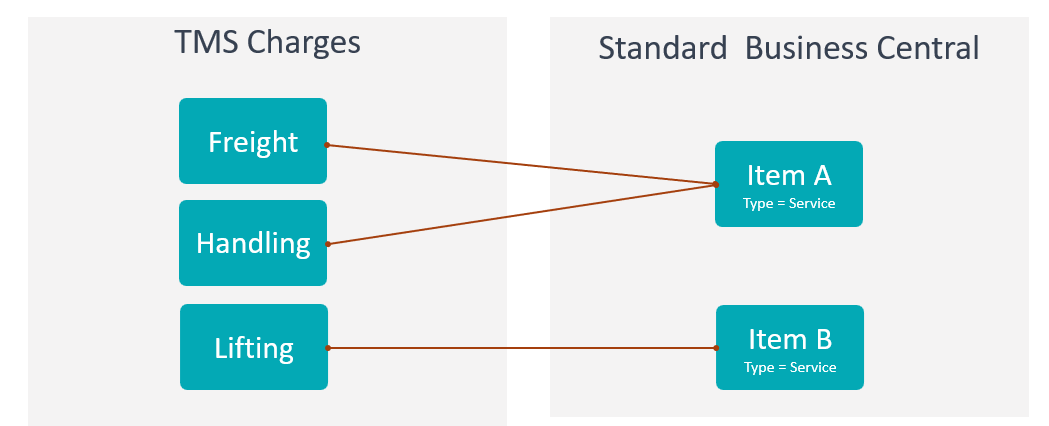
- Set Purchase Line - Type and Purchase Line - No. to the Business Central line type and record used for this cost.
- Fill Unit of Measure Code and Default Vendor No. when the charge should supply these defaults.
Fields that matter most
| Field | Why it matters |
|---|---|
| No. | The charge identifier selected in Code on settlement lines. |
| Description | Appears on cost lines, reports, and documents. |
| Unit of Measure Code | Supplies the default unit for the charge quantity. |
| Default Vendor No. | Supplies the default supplier for the cost. |
| Purchase Line - Type | Defines the Business Central purchase line type, such as G/L Account, Charge (Item), or a service Item. |
| Purchase Line - No. | Identifies the account, item charge, or service item. The purchase line must use the matching type and number when its cost is imported. |
Where charges are used
| Area | Use |
|---|---|
| Freight Order | Records expected or actual carrier cost. |
| Freight Agreements | Defines reusable carrier cost lines and calculation flags. |
| Settlement | Allocates cost to the Forwarding Order and calculates margin. |
| Purchase Assignment | Maps vendor purchase lines into Freight Order charges and settlement cost. |
| Purchase processing | Supports vendor invoice or cost document creation. |
| Reporting | Shows cost structure by charge type. |
Good to know
- Use short, stable charge codes. They become reporting dimensions for cost analysis.
- Keep service codes and charge codes separate. It helps users understand income versus cost.
- For an ordinary manual Settlement Cost line, use Financial Effect = Standard. Enter Quantity and Price as they should appear on the purchase document: with Pricing Mode = Per Unit, quantity
1and price700produce Amount = 700 and P/L Amount = -700 before discounts. - With Pricing Mode = Fixed Amount, enter the document amount before line discount, normally Amount = 700 for a cost of
700. Settlement applies the financial direction to P/L automatically. Deliberately negative quantities, prices, and amounts remain available. For supplier credits, use Financial Effect = Credit and review the quantity, price, and amount signs. - When a vendor invoice already exists, follow Purchase Assignment to import its cost. Check for a matching draft cost first so that the invoice does not duplicate an estimate.
Troubleshooting
| Problem | What to check |
|---|---|
| Charge cannot be selected | Check the charge exists and is included in the Forwarding Order Type’s allowed service/charge set when one is configured. |
| Cost does not post correctly | Review Purchase Line - Type, Purchase Line - No., vendor, and Business Central posting setup. |
| Margin is wrong | Review Financial Effect, Pricing Mode, amount signs, currency, allocation, and duplicate costs. |
| Cost cannot be allocated | Check the settlement line status and linked Forwarding Order. |
| Purchase invoice line cannot be matched | Check charge setup and Purchase Assignment. |